

What is Automated Manufacturing Equipment? | A Comprehensive Guide
Automated manufacturing equipment represents a transformative class of machinery and systems designed to perform production tasks with minimal human intervention. By integrating advanced technologies such as robotics, computer numerical control (CNC), artificial intelligence (AI), and sophisticated software, this equipment handles processes ranging from assembly and machining to inspection and packaging. The core objective is to enhance efficiency, consistency, and scalability in manufacturing operations, moving beyond traditional manual methods to create smarter, more responsive, and highly efficient production environments.
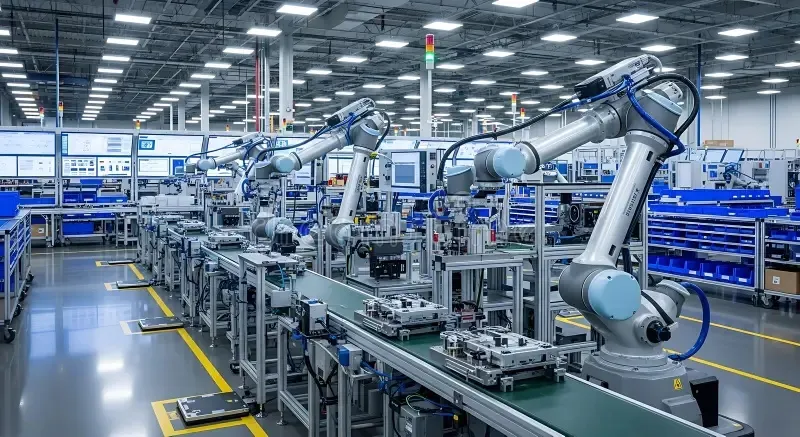
Figure 1: A modern automated manufacturing cell featuring collaborative robots (cobots) and conveyor systems.
Core Components of Automated Manufacturing Systems
Automated manufacturing is not a single machine but a synergistic system. Its effectiveness hinges on several integrated components working in unison.
1. Robotics and Manipulators
Industrial robots are the most visible element. These programmable mechanical arms perform repetitive, precise, or hazardous tasks such as welding, painting, assembly, and material handling. Articulated, SCARA, and Cartesian robots are common types, each suited for specific applications.
2. Computer Numerical Control (CNC) Machines
CNC equipment, including mills, lathes, and routers, uses pre-programmed software to control the movement of tools. This allows for the high-precision machining of complex parts from various materials, ensuring repeatability across thousands of units.
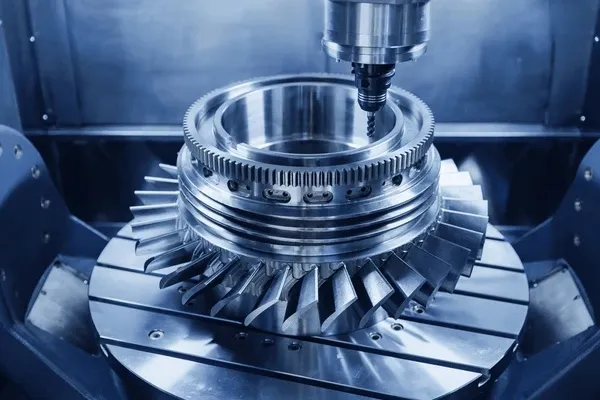
Figure 2: A CNC milling machine executing a precise cutting operation on a metal workpiece.
3. Sensors and Vision Systems
These are the "senses" of the automated system. Sensors (proximity, temperature, force) and machine vision cameras collect real-time data on position, quality, and environmental conditions, enabling immediate feedback and adjustment.
4. Programmable Logic Controllers (PLCs) and Industrial PCs
Acting as the system's "brain," PLCs and industrial computers receive input from sensors, execute control logic, and output commands to actuators and robots, orchestrating the entire sequence of operations.
5. Material Handling Systems
This includes automated guided vehicles (AGVs), conveyor belts, and automated storage and retrieval systems (AS/RS). They ensure the seamless and timely movement of raw materials, work-in-progress, and finished goods throughout the facility.
Major Types of Automated Manufacturing Equipment
The application of automation varies widely across industries. The table below categorizes key equipment types by their primary function.
| Equipment Type | Primary Function | Common Examples | Typical Industries |
|---|---|---|---|
| Fixed Automation | High-volume, dedicated production of a single part. | Automated assembly lines, transfer machines. | Automotive, Consumer Electronics |
| Programmable Automation | Batch production; equipment can be reprogrammed for new product designs. | Industrial Robots, CNC Machines. | Aerospace, Heavy Machinery |
| Flexible Automation | Mid-volume, multi-product production with quick changeovers. | Robotic cells with tool changers, FMS (Flexible Manufacturing Systems). | Medical Devices, Custom Manufacturing |
| Inspection & Quality Control | Automated measurement and defect detection. | Machine Vision Systems, Coordinate Measuring Machines (CMM). | Pharmaceuticals, Semiconductors |
Key Benefits and Advantages
The adoption of automated manufacturing equipment delivers profound competitive advantages.
Enhanced Productivity & Efficiency: Machines operate 24/7 without fatigue, significantly increasing output and reducing cycle times.
Superior Quality & Consistency: Automation eliminates human error, ensuring every product meets exact specifications with minimal variance.
Improved Workplace Safety: Dangerous tasks (handling toxic materials, heavy lifting) are assigned to robots, reducing workplace accidents.
Reduced Operational Costs: While initial investment is high, automation lowers long-term labor, scrap, and rework costs.
Increased Production Flexibility: Modern flexible systems can be quickly reconfigured to produce different products, aiding in mass customization.
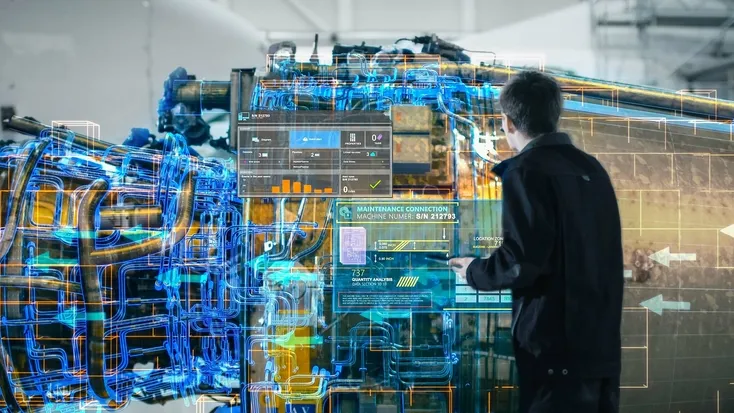
Figure 3: An operator interfaces with a Digital Twin simulation for real-time monitoring and optimization of an automated line.
The Future: Trends Shaping Next-Generation Automation
The evolution of automated manufacturing is accelerating, driven by several key trends.
Artificial Intelligence and Machine Learning
AI algorithms are moving beyond simple execution to enable predictive maintenance, real-time process optimization, and adaptive quality control, making systems truly intelligent.
Collaborative Robots (Cobots)
Designed to work safely alongside humans without safety cages, cobots are making automation accessible and cost-effective for small and medium-sized enterprises (SMEs).
Industrial Internet of Things (IIoT) and Digital Twins
IIoT connects machines to collect vast operational data. This data fuels Digital Twins—virtual replicas of physical systems—used for simulation, performance analysis, and remote troubleshooting.
Additive Manufacturing Integration
3D printers are being integrated into automated production lines for on-demand fabrication of tools, jigs, and even end-use parts, complementing subtractive CNC processes.
In conclusion, automated manufacturing equipment is the cornerstone of modern industry, driving the shift towards Industry 4.0. It encompasses a diverse ecosystem of intelligent machines that work together to create safer, more efficient, and more adaptable production facilities. As technologies like AI and IIoT continue to mature, the capabilities and strategic importance of this equipment will only grow, fundamentally reshaping the global manufacturing landscape.